Doctors Can Now Predict Heart Failure Survival Without Touching the Patient: Study
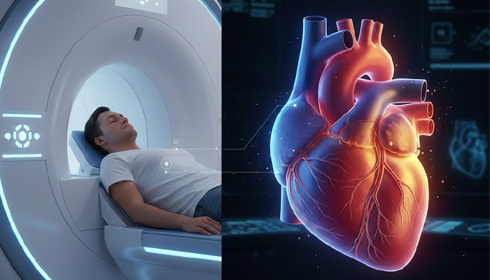
Doctors may soon be able to identify how dangerously ill a heart failure patient is—and even predict their odds of survival—by performing a normal MRI scan without introducing a single tube into the heart. According to new research from the University of East Anglia (UEA), the scan can silently disclose hidden danger indications that routine diagnostics frequently overlook, providing clinicians with a glimpse into a patient's future health.
Heart failure affects hundreds of millions of people globally and is the leading cause of hospitalisation among older persons. It occurs when the heart becomes unable to pump enough blood to meet the body's demands. One of the most critical indicators of how badly the heart is straining is how much oxygen stays in the blood returning to the heart. Until now, measuring this characteristic has typically required right cardiac catheterisation—an invasive procedure in which a tube is put into the heart.
The surgery can be painful and hazardous, especially for aged, weak, or critically ill individuals. This has prompted a long-standing issue among both doctors and patients: is there a safer way to obtain the same life-saving information?
According to UEA experts, the answer could be yes.
"Our breakthrough could be a game changer for assessing advanced heart failure," said Prof. Pankaj Garg of the UEA's Norwich Medical School, who led the research. "We wanted to develop a safe, non-invasive alternative which could allow far more patients to be properly assessed—and allow repeat monitoring without the risks of a catheter test."
The scientists discovered that a typical cardiac MRI scan can measure blood oxygen levels using a technique known as T2 mapping. Simply put, blood with more or less oxygen reacts differently under a magnetic field. By monitoring these minor changes, the researchers developed a formula for predicting oxygen levels without collecting blood or inserting tubes.
To test the procedure, the scientists examined 30 individuals and compared MRI estimations to data from standard catheter examinations. The readings were remarkably similar. They then monitored 628 newly diagnosed heart failure patients for around three years.
The findings were remarkable. Patients whose MRI scans revealed higher oxygen levels were considerably less likely to die or be admitted to the hospital for heart failure. Importantly, the scan remained a favourable predictor after controlling for age, other disorders, and general heart function. In effect, the MRI served as a crystal ball, determining who was at higher risk well before a crisis arose.
"One of the most important markers in advanced heart failure is how much oxygen is left in blood returning to the right side of the heart," according to Prof. Garg. "Our study shows it can be estimated non-invasively from a standard heart MRI."
Dr. Gareth Matthews, a coauthor, emphasised the practical implications. "Because this can be done as part of a standard cardiac MRI, it needs no extra hardware and no contrast dye and adds only seconds to the scan," he told me. "It has real potential to widen access to safer heart failure assessment across the NHS."
The findings inevitably raise issues that many patients and families have previously asked. Can an MRI accurately estimate how long a cardiac patient will live? Is it safer than angiography or catheterisation? Could it help reduce repeat hospitalisations? Will such scans become routine, and who should have them first?
While the results appear encouraging, the experts advise caution. More research is needed to confirm the findings in various institutions and patient populations, as well as to determine how to best apply the information in everyday treatment decisions.
Still, the consequences are difficult to ignore. By transforming a common scan into a potent early warning tool, clinicians may soon be able to monitor heart failure more safely, often, and accurately—without touching the patient at all.
JACC Advances published a study titled "Development and validation of a non-invasive model of mixed venous oxygen saturation in heart failure."
Be first to post your comments